


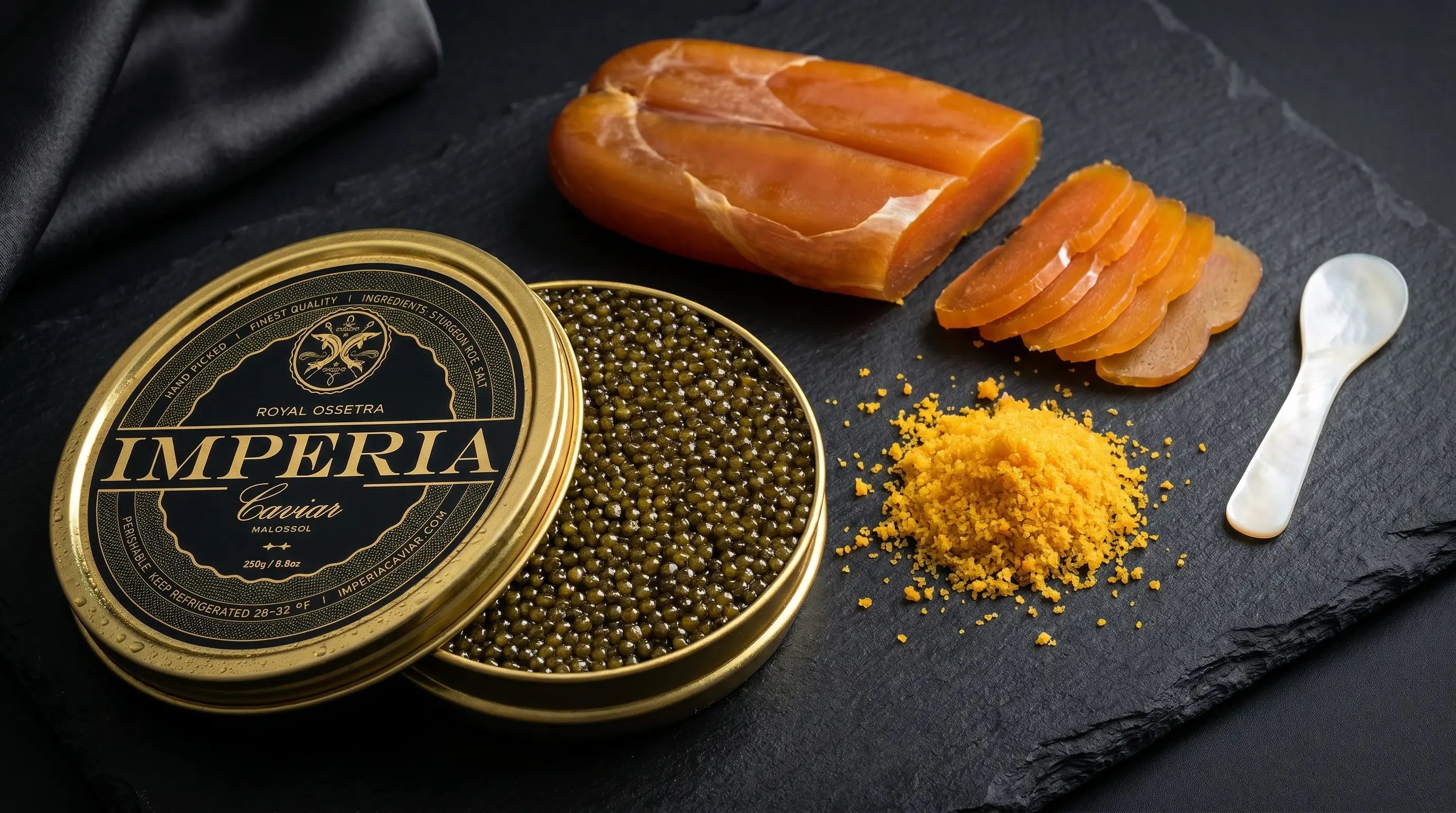
What Is Mullet Roe? A Simple Guide to Bottarga
Quick Answer: Mullet roe is the salt-cured, air-dried egg sac of grey mullet, sold as the Mediterranean delicacy bottarga. Unlike caviar's loose eggs, it is one solid, shelf-stable block with an intense umami, briny, nutty flavor.
Key Takeaways:
-
Bottarga is a whole cured roe sac, not loose eggs like caviar or tobiko.
-
The flavor is intensely savory and briny with nutty, almond-like notes, not "fishy."
-
A little goes far. Bottarga is a finishing seasoning, not a main ingredient.
-
Top-quality mullet roe comes from Sardinia, Greece, and select Mediterranean producers.
-
Imperia Caviar carries premium roe and seafood for anyone ready to taste it firsthand.
Mullet roe is one of the oldest preserved foods on earth. Yet most people outside the Mediterranean have never encountered it. Those who have often confuse it with caviar, which is an entirely different product.
This guide covers what mullet roe is, how it is made, what it tastes like, and how to buy, store, and eat it.
Let’s get started!
What Is Mullet Roe?
Mullet roe is the salt-cured and air-dried egg sac of the grey mullet (Mugil cephalus). Known as bottarga in Italy, karasumi in Japan, and poutargue in France, this amber-colored delicacy is prized for its intense umami flavor. Cooks use it as a finishing seasoning, grating it over pasta, eggs, and vegetables.
The distinction that sets bottarga apart from other fish roe products: the entire roe sac is cured intact. Caviar, tobiko, and ikura are individual loose eggs, brined and served fresh.
Bottarga is a single solid block, dried and shelf-stable, closer to an aged cheese than a fresh seafood product.
The term "mullet roe" can refer to both the fresh, uncured eggs and the finished cured product. Throughout this article, we focus on the cured form: bottarga.
Mullet Roe Around the World: Names, Traditions, and Variations
The practice of curing fish roe dates back over 3,000 years. Phoenician traders are credited with spreading the technique across the Mediterranean. Bottarga production is documented in the Nile Delta as early as the 10th century BCE.
The word "bottarga" traces through the Arabic "butarḫah" (salted fish roe), which itself derives from the Byzantine Greek "otarikhon," combining "egg" and "pickled."
Despite different names and local preparation methods, the core product is the same everywhere: a salted, pressed, and dried roe sac.
|
Name |
Country / Region |
Distinct Preparation Note |
|
Bottarga |
Italy (Sardinia, Sicily) |
Gold standard. Sardinian Bottarga di Muggine from Cabras lagoon is the most prized. |
|
Karasumi |
Japan |
Progressively sun-dried and pressed repeatedly. Eaten with sake as a delicacy. |
|
Poutargue / Boutargue |
France (Provence, Corsica) |
Often sealed in beeswax. Central to Provençal cuisine. |
|
Avgotaraho |
Greece (Messolonghi) |
Coated in beeswax after salting. Holds EU Protected Designation of Origin status. |
|
Batarekh |
Egypt |
One of the oldest continuous traditions. Salted and sun-dried along the Nile Delta. |
|
Wuyuzi |
Taiwan |
Softer and moister than Mediterranean versions. Often seared and sliced thin. |
|
Eoran |
Korea |
Made from mullet or freshwater drum. Seasoned with soy and regional spices. |
|
Botargo |
Spain |
Made from grey mullet or bonito. Common in Murcia and the Balearics. |
How Is Mullet Roe Made?
Bottarga production is entirely artisanal. Every step is done by hand, from extraction to final packaging. There is no mechanized shortcut.
-
Extraction. The roe sac is removed from the female grey mullet without rupturing the membrane. One wrong cut floods the eggs with blood and ruins the batch. This step requires years of training.
-
Salting. The intact sacs are buried in sea salt for several days. Salt draws out moisture and begins the curing process. Producers change the salt periodically to maintain consistency.
-
Pressing. Wooden boards and weights flatten the sacs, expelling additional liquid and giving bottarga its characteristic shape.
-
Air-drying. The pressed sacs hang in cool, ventilated rooms for weeks to months. The producer monitors firmness and color, waiting for the deep amber hue that signals a finished product.
Weight loss during curing runs 40 to 50 percent. One kilogram of fresh roe yields only 500 to 600 grams of finished bottarga. This yield loss, combined with the manual labor, drives the high price.
The premier production regions are Sardinia (particularly the Cabras lagoon in Oristano province) and Messolonghi, Greece, where avgotaraho holds Protected Designation of Origin status.
What Does Mullet Roe Taste Like?
Bottarga is not "fishy" in the way most people expect. That concern fades after the first taste.
The flavor is intensely savory with a briny undercurrent. There is a distinct nuttiness, almost like bitter almond, that lingers on the finish. Underneath sits a clean, salt-air quality that recalls a Mediterranean coast more than a fish market.
Texture depends on how you serve it. Sliced thin, bottarga is waxy and firm, softening on the tongue. Grated with a Microplane, it becomes a fluffy powder that melts into hot dishes on contact.
The closest analogy: think of bottarga as the seafood equivalent of aged Parmesan. It is a concentrated flavor source you use sparingly. A few grams transform a dish.
How Does Mullet Roe Compare to Caviar, Tobiko, and Other Roe?
These are all fish eggs. The similarities end there. Processing, texture, flavor, and use cases differ completely.
|
Feature |
Mullet Roe (Bottarga) |
Sturgeon Caviar |
Tobiko |
Ikura (Salmon Roe) |
|
Processing |
Whole sac salt-cured and air-dried |
Individual eggs brined fresh (malossol) |
Individual eggs brined, often flavored |
Individual eggs brined in soy or salt |
|
Texture |
Firm, waxy solid; grated or sliced |
Soft spheres that pop |
Small, crunchy |
Large, burst with liquid |
|
Flavor |
Intense umami, briny, nutty |
Buttery, creamy, subtle brine |
Mild, slightly sweet, smoky |
Rich, briny, slightly sweet |
|
Primary Use |
Finishing seasoning (grated over dishes) |
Eaten on its own or with blinis |
Sushi garnish |
Sushi topping, rice bowls |
|
Shelf Life |
Months (refrigerated, cured) |
Weeks (fresh, perishable) |
Weeks (fresh) |
Weeks (fresh) |
|
Price Tier |
€100–250+/kg |
€50–2,000+/100g |
€15–40/100g |
€20–60/100g |
The takeaway: bottarga is a cured, shelf-stable, solid block used as a seasoning. Caviar, tobiko, and ikura are fresh, perishable individual eggs eaten on their own or as garnish. They fill different roles in the kitchen entirely.
Curious about caviar and roe? Browse Imperia Caviar’s roe and seafood collection to taste the difference firsthand.
Mullet Roe vs. Tuna Bottarga: Which Should You Try?
Not all bottarga comes from mullet. Tuna bottarga (Bottarga di Tonno) is the other major variety, especially in Sicily. The two are distinct products.
-
Flavor: Mullet bottarga is more delicate, refined, and nutty. Tuna bottarga is stronger, more assertive, and very salty.
-
Color: Mullet is amber to golden-orange. Tuna is dark reddish-brown, almost purple.
-
Texture: Mullet is smoother and waxy. Tuna is harder, drier, and more granular.
-
Price: Mullet bottarga is generally more expensive and is considered the premium choice.
If you are new to bottarga, start with mullet. Its balanced flavor makes a better introduction. Move to tuna bottarga when you want something bolder.
How to Eat Mullet Roe
The most important thing to know: bottarga is a finishing seasoning, not a cooking ingredient. Heat degrades the flavor, so always add it at the very end.
-
Grated over pasta. The classic preparation. Cook spaghetti al dente. Toss with garlic-infused olive oil, a squeeze of lemon, and a pinch of chili flake. Grate bottarga generously over the top just before serving.
-
Shaved over eggs. Thin slices over soft-scrambled or fried eggs. The residual heat softens the bottarga without cooking it.
-
On crostini. Paper-thin slices on toasted bread drizzled with extra virgin olive oil. Add a drop of lemon juice. This is the purest way to taste the product.
-
Over vegetables. Grated over steamed asparagus, roasted cauliflower, or a simple green salad with lemon vinaigrette.
Wine and Beverage Pairings
Bottarga pairs best with dry white wines: Vermentino from Sardinia, Greco di Tufo, or Falanghina. Champagne and dry sparkling wines also work well. In the Japanese tradition, karasumi is served alongside sake. For a modern pairing, try a crisp gin and tonic.
The ingredient makes the dish. Explore Imperia Caviar’s roe and seafood collection for premium bottarga and specialty roe.
How to Buy and Store Mullet Roe
What to Look for When Buying
-
Color: Uniform deep amber or golden-orange. Avoid pieces that are pale, grey, or have dark spots.
-
Firmness: It should feel solid, like aged hard cheese. Soft or mushy bottarga has been improperly cured.
-
Surface: A smooth, slightly oily sheen indicates freshness. The interior should look compact when sliced.
-
Origin: Sardinian bottarga (especially from the Cabras lagoon) and Greek avgotaraho from Messolonghi are the gold standards. Always check the label.
Expect to pay €100 to €250 or more per kilogram for quality mullet bottarga. European specialty retailers and online shops like Imperia Caviar ship throughout Europe.
How to Store Bottarga
Unopened, vacuum-sealed or wax-coated bottarga keeps for months in a cool, dark place.
Once opened, wrap the exposed end tightly in plastic wrap and refrigerate. It will last several more months.
Do not freeze bottarga. Freezing damages the texture and dulls the flavor.
Mullet Roe Nutrition: Is It Good for You?
Bottarga is nutrient-dense in small servings. A typical portion is 10 to 15 grams, roughly 40 to 60 calories.
-
Protein: Approximately 36 to 40 grams per 100 grams. Bottarga is a highly concentrated protein source, though serving sizes are small.
-
Omega-3 fatty acids: Rich in EPA and DHA, both critical for brain and heart health.
-
Vitamins and minerals: Good source of vitamins A, D, and B12, plus zinc and selenium.
-
Sodium: High, at approximately 1,700 milligrams per 100 grams. In a typical 10 to 15 gram serving, that translates to 170 to 255 milligrams. Manageable for most people, but worth noting if you monitor salt intake.
Think of bottarga as a nutrient-dense garnish, not a staple protein source. The small serving size keeps calories and sodium in check while delivering concentrated nutrition.
Conclusion
Mullet roe, in its cured form as bottarga, is one of the world’s oldest and most flavorful preserved foods. A single ingredient transforms a bowl of spaghetti, a fried egg, or a slice of bread into something memorable.
Start small. Buy a quality piece, grate it over a simple pasta with olive oil and lemon, and let the flavor speak for itself. Once you experience it, you will understand why cooks across the Mediterranean, Japan, and beyond have treasured this ingredient for over 3,000 years.
Ready to try it? Explore Imperia Caviar’s roe and seafood collection for premium bottarga, specialty roe, and everything you need to elevate your next meal!


