


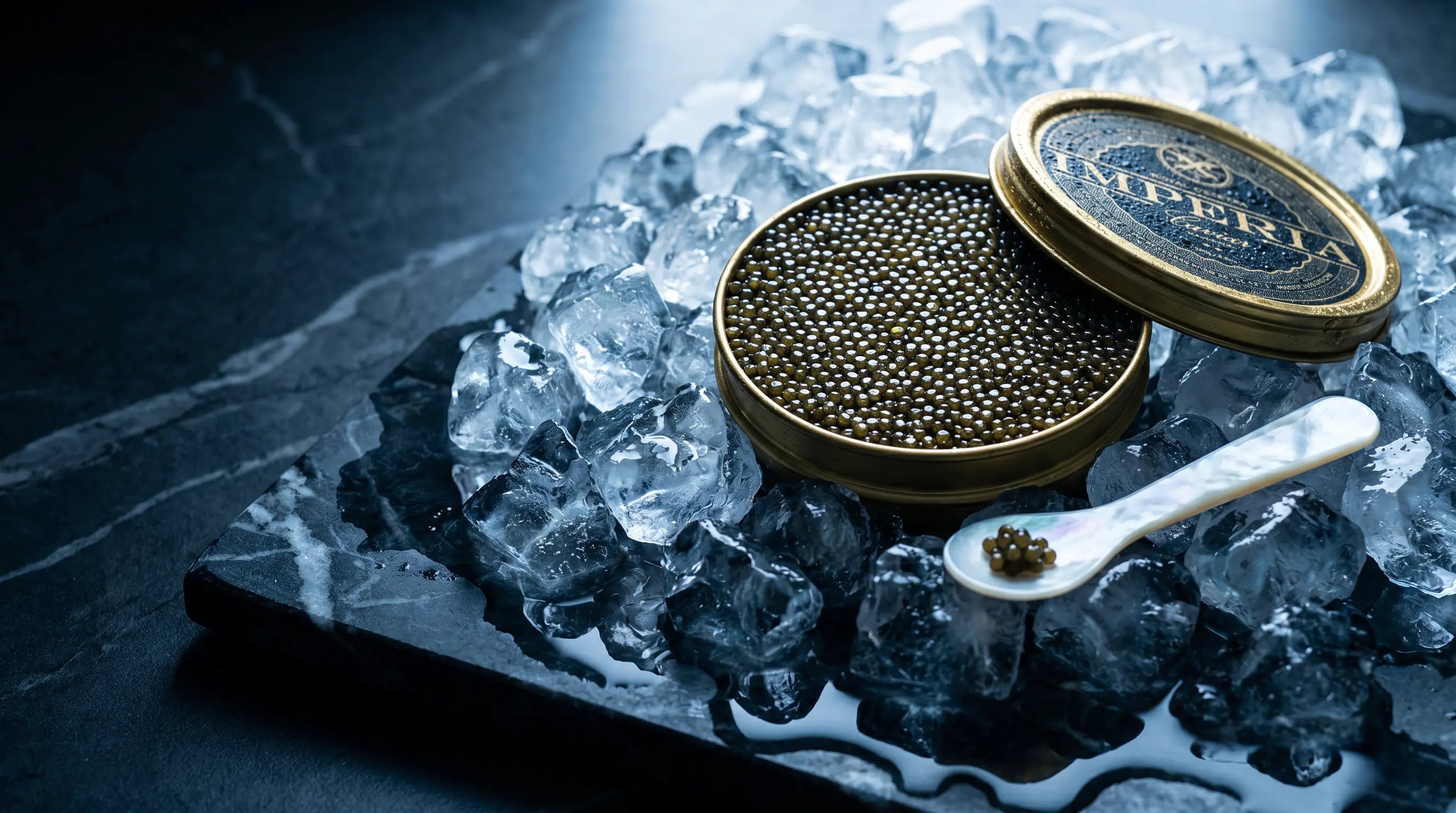
Can You Freeze Caviar?
Quick Answer: You can freeze caviar, but ice crystals rupture the delicate roe membranes, destroying the signature pop and layered flavor. If you must freeze, keep caviar sealed in the original tin and thaw slowly in the fridge for 24 hours.
Key Takeaways:
-
Freezing damages caviar texture irreversibly. The signature “pop” is lost once ice crystals puncture the egg membranes.
-
If you must freeze, keep caviar sealed in the original tin and thaw slowly in the fridge for at least 24 hours.
-
Pasteurized caviar tolerates freezing slightly better than fresh malossol roe.
-
The ideal storage temperature is −2°C to 0°C (28 to 32°F): very cold, but not frozen.
-
Previously frozen caviar works best folded into sauces, omelettes, or warm pasta dishes.
You spent good money on quality caviar. Now it is sitting in your fridge, approaching its best-by date, and your freezer is right there. The impulse to freeze it makes sense. Chefs, caterers, and caviar producers all face the same dilemma with surplus roe.
The short answer is that freezing is technically possible but almost always a bad trade.
In this article, we cover what happens when caviar freezes and when the trade-off is worth making. We also explain how to minimise the damage and why correct cold storage eliminates the need entirely.
Let's get started!
What Happens When You Freeze Caviar
Each caviar pearl is a tiny, self-contained capsule. A thin membrane holds in natural oils, moisture, and the concentrated flavour compounds that define varieties like Osetra and Kaluga. That membrane is fragile by design. It is meant to burst cleanly on the palate, delivering the characteristic “pop” that distinguishes premium roe.
When caviar enters a home freezer (typically set to −18°C or 0°F), the water inside each egg freezes slowly. Slow freezing is the problem. It allows large ice crystals to form, and these jagged structures puncture the membrane from the inside. The tears are microscopic but irreversible.
Compare this to industrial blast freezing, which some producers use for long-distance transport. Blast freezers operate at −30°C to −40°C and chill the product in minutes rather than hours.
At that speed, ice crystals stay very small. Small crystals cause far less structural damage. A standard home freezer cannot replicate this speed, which is why producer-frozen caviar can survive the process while home-frozen caviar rarely does.
After thawing, the damage shows up in three distinct ways.
Texture loss. Eggs that once popped cleanly between your teeth feel mushy and fragile. The membrane no longer contains the interior; it collapses on contact.
Brine weeping. The tin pools with liquid, a mix of brine and the natural oils that leaked through ruptured membranes. This is not condensation. It is the inside of the egg draining out.
Flavour flattening. Fresh malossol caviar delivers layered notes: butter, sea salt, a hint of nuttiness. After freezing and thawing, those layers compress into something duller and one-dimensional. The finish shortens. The complexity that justified the price is gone.
When Is Freezing Caviar Acceptable
Freezing is not always wrong. It is wrong most of the time, but two situations make it defensible.
Scenario 1: surplus approaching its expiry date. If you have unopened tins nearing their best-by date and no realistic plan to serve them, freezing is better than throwing them away. The caviar will lose quality, but it will remain safe and usable in cooked dishes.
Scenario 2: pasteurized or lower-grade roe. Pasteurized caviar has undergone gentle heat treatment that firms the egg membrane slightly. This makes it more resilient to freezing than fresh malossol roe. If you are freezing pasteurized caviar for later use in recipes, the texture trade-off is smaller.
The line is clear. If the caviar is premium fresh malossol and you plan to serve it on a spoon or blini, do not freeze it. If it is headed for a sauce or an omelette where texture is secondary, freezing is an acceptable compromise.
One more consideration: the variety matters. Larger-grained caviars like Beluga and Kaluga tend to be more vulnerable to ice crystal damage. Their softer, more delicate membranes offer less resistance to crystal formation. Smaller-grained varieties like Sevruga hold up marginally better, though the quality loss is still significant.
Imperia Caviar ships fresh malossol roe packed with insulated cold packs, designed for immediate enjoyment. Browse our caviar collection!
How to Freeze Caviar If You Must
When freezing is unavoidable, these steps limit the damage.
Freezing:
-
Keep the caviar in its original sealed tin. Do not open it or transfer to another container.
-
Place the tin inside a resealable freezer bag. Press out as much air as possible before sealing.
-
Set your freezer to its coldest setting. The colder the temperature, the smaller the ice crystals and the less damage to the roe.
-
Store the tin at the back of the freezer, away from the door, where the temperature is most stable.
-
Label the bag with the date. Plan to use the caviar within three months for the best quality.
Thawing:
-
Move the sealed tin from the freezer to the coldest part of your fridge.
-
Allow at least 24 hours for a slow, gentle thaw. Never thaw at room temperature.
-
Once thawed, use the caviar immediately. Do not refreeze under any circumstances.
A few common mistakes to avoid. Do not thaw caviar in warm water, in the microwave, or on the counter. Rapid temperature changes cause the eggs to sweat and lose moisture faster. Do not open the tin before thawing is complete; exposing partially frozen roe to air accelerates oxidation and off-flavours.
Even done perfectly, this process will not restore the original texture. You are reducing damage, not preventing it.
Fresh Caviar vs Frozen Caviar: Side by Side
Reading about texture loss and flavour flattening is one thing. Seeing the differences side by side makes the trade-off concrete.
|
Fresh (Properly Stored) |
Frozen (Home Freezer, Thawed) |
|
|
Texture |
Firm, distinct pop |
Soft, mushy, fragile |
|
Flavour |
Layered: buttery, briny, nutty |
Flat, one-dimensional |
|
Appearance |
Glossy, separate pearls |
Dull, clumped, weeping liquid |
|
Best Use |
Blini, tasting spoon, garnish |
Sauces, omelettes, warm dishes |
|
After Opening |
Consume within 24 to 48 hours |
Consume immediately after thawing |
What to Do With Previously Frozen Caviar
Frozen caviar is not ruined. It is repurposed. The texture shift that disqualifies it from a tasting spoon becomes irrelevant the moment the roe meets heat. In warm dishes, the eggs melt into the surrounding ingredients, contributing briny richness without needing to pop.
Béarnaise or beurre blanc sauce. Stir the thawed caviar into a warm butter sauce at the very last second, off the heat. The gentle warmth releases the briny flavour without cooking the eggs further.
Scrambled eggs or omelette. Fold the caviar into soft scrambled eggs just before plating. The residual heat is enough. Adding it too early toughens the roe.
Pasta garnish. Toss thawed caviar through hot linguine with lemon, crème fraîche, and chives. Serve immediately.
Crème fraîche dip. Blend the caviar into crème fraîche with a squeeze of lemon for crostini or blini. Our guide to how to eat caviar covers more pairing ideas.
Prefer to skip the compromises? Start with fresh roe instead. Explore Imperia Caviar’s collection!
The Best Way to Store Caviar Instead of Freezing
The reason people consider freezing caviar is usually the same: they are worried it will go bad before they can eat it. Proper cold storage solves that problem without any sacrifice in quality.
Keep unopened tins at −2°C to 0°C (28 to 32°F). In a home fridge, the coldest spot is typically the back of the lowest shelf. Avoid the door, where the temperature swings every time you open it. If possible, place the tin on a small bed of crushed ice inside the fridge for extra stability.
Unopened caviar keeps for several weeks when stored at the correct temperature. Always follow the producer’s best-by date. Once you open a tin, press a sheet of plastic wrap directly onto the surface of the roe to block air contact. Replace the lid firmly and consume within 24 to 48 hours.
If you are buying caviar ahead of an event, order it as close to the date as practical rather than weeks in advance. This simple habit eliminates the surplus problem that leads people to the freezer in the first place.
Conclusion
Can you freeze caviar? Technically, yes.
Should you? Almost never.
The experience that makes caviar worth buying, the clean pop, the layered flavour, the glossy sheen, does not survive ice crystals.
If surplus roe is approaching its date, freezing salvages it for sauces and warm dishes. For everything else, proper refrigeration at −2°C to 0°C is the answer.
Plan your portions, store tins in the coldest part of the fridge, and serve caviar within a day or two of opening. That discipline protects your investment far better than any freezer can.
The best caviar experience starts with fresh, properly stored roe. Explore Imperia Caviar’s premium collection!


