

Caviar vs Tobiko: Key Differences Explained
Quick Answer: Caviar is salt-cured sturgeon roe with large, soft eggs that pop with a buttery release, while tobiko is tiny, crunchy flying fish roe used as a garnish. Caviar costs €45 to €280+ per ounce and stars as a standalone delicacy; tobiko costs €4 to €8 and brightens sushi and poke bowls.
Key Takeaways:
-
Caviar comes exclusively from sturgeon. Tobiko comes from flying fish. Only sturgeon roe qualifies as true caviar.
-
Caviar eggs measure 2–3 mm, feel soft and buttery, and pop with a creamy release. Tobiko eggs are under 1 mm and deliver a firm, audible crunch.
-
Caviar ranges from €45 to €280+ per ounce. Tobiko costs roughly €4–8 per ounce. The gap reflects sturgeon rarity and years-long maturation.
-
Caviar is served as a centerpiece with minimal accompaniment. Tobiko is sprinkled as a garnish on sushi, poke bowls, and seafood dishes.
-
Both are rich in omega-3 fatty acids, protein, and B12, but they fill fundamentally different roles at the table.
You’ve seen both on restaurant menus and Instagram feeds: glossy black pearls of caviar beside bright orange clusters of tobiko. They look like cousins. They’re both fish eggs. But the similarities mostly stop there.
The confusion is understandable. Restaurants and grocery stores sometimes label tobiko as “caviar,” blurring a distinction that matters for flavor, price, and how you use each ingredient. If you’re spending money on either one, the differences are worth knowing.
This guide compares caviar and tobiko side by side: origin, taste, texture, egg size, nutrition, price, and sustainability.
Caviar vs Tobiko at a Glance
|
Caviar |
Tobiko |
|
|
Source Fish |
Sturgeon (Beluga, Osetra, Sevruga, Kaluga) |
Flying fish (Cheilopogon agoo) |
|
Egg Size |
2–3 mm |
Under 1 mm |
|
Color |
Black, gray, gold, brown, green |
Orange (natural); green, black, yellow, red (infused) |
|
Texture |
Soft, buttery, melts on the tongue |
Firm, crunchy, pops with a snap |
|
Flavor |
Rich, briny, nutty to creamy depending on species |
Mild, smoky, lightly sweet with salt finish |
|
Price per Ounce |
€45–€280+ |
€4–8 |
|
Primary Use |
Standalone delicacy; blinis, crème fraîche, champagne |
Garnish; sushi rolls, poke bowls, sashimi |
|
Shelf Life (Opened) |
2–3 days refrigerated |
3–5 days refrigerated |
What Is Caviar?
Caviar is the salt-cured roe of sturgeon, a family of ancient fish that can take 8 to 20 years to reach reproductive maturity. That timeline explains much of the price. No other commercially harvested fish demands that kind of patience.
Several sturgeon species produce distinct caviar varieties. Beluga yields the largest, rarest, and most expensive eggs.
Osetra produces medium-sized pearls with a nutty character. Sevruga offers smaller eggs with a more intense brininess. Kaluga, a river sturgeon, serves as a popular Beluga alternative with similarly large, buttery eggs.
The term “caviar” applies only to sturgeon roe. Other fish eggs are roe, not caviar, regardless of how they’re labeled on a menu.
Browse Imperia’s full caviar collection!
What Is Tobiko?
Tobiko is the roe of flying fish, most commonly harvested from Cheilopogon agoo, the Japanese flying fish. The eggs measure less than 1 millimeter across. Individually, they’re barely perceptible. Eaten by the spoonful, they deliver a signature crunch and a mild, smoky-sweet brininess.
In its natural state, tobiko is reddish-orange. It’s frequently infused with other ingredients to shift both color and flavor. Green tobiko gets its heat from wasabi. Black tobiko draws umami depth from squid ink. Yellow tobiko picks up citrus brightness from yuzu. Red tobiko takes on spice from chili or earthiness from beet.
Tobiko is sometimes marketed as “caviar” or “flying fish caviar.” That label is inaccurate. True caviar comes from sturgeon only.
Key Differences Between Caviar and Tobiko
Taste and Flavor
Caviar delivers layered complexity. Depending on species, expect butter, brine, cream, or roasted nuts. Osetra is often described as hazelnut-like. Sevruga hits harder with a sharp, ocean-forward salt. The flavor lingers and evolves.
Tobiko is simpler. The base flavor is mildly smoky with a light sweetness and a clean salt finish. Infused varieties add a single dominant note (wasabi heat, squid ink umami, yuzu tartness), but the underlying profile stays mild. Tobiko complements. Caviar commands.
Texture and Egg Size
Caviar eggs range from 2 to 3 mm in diameter. They’re soft, almost fragile, and burst gently against the palate with a buttery release. The mouthfeel is smooth and melting.
Tobiko eggs are a fraction of that size, under 1 mm. Their outer membrane is firmer, producing an audible crunch when bitten. Where caviar melts, tobiko snaps. That textural contrast is why chefs pair tobiko with soft-textured dishes like sushi rice and avocado.
How They’re Used in the Kitchen
Caviar is treated as a centerpiece. It’s served chilled on a bed of ice, often with blinis, crème fraîche, or a mother-of-pearl spoon. Pairings stay neutral (toast points, mild crackers, champagne) so the caviar’s complexity takes center stage.
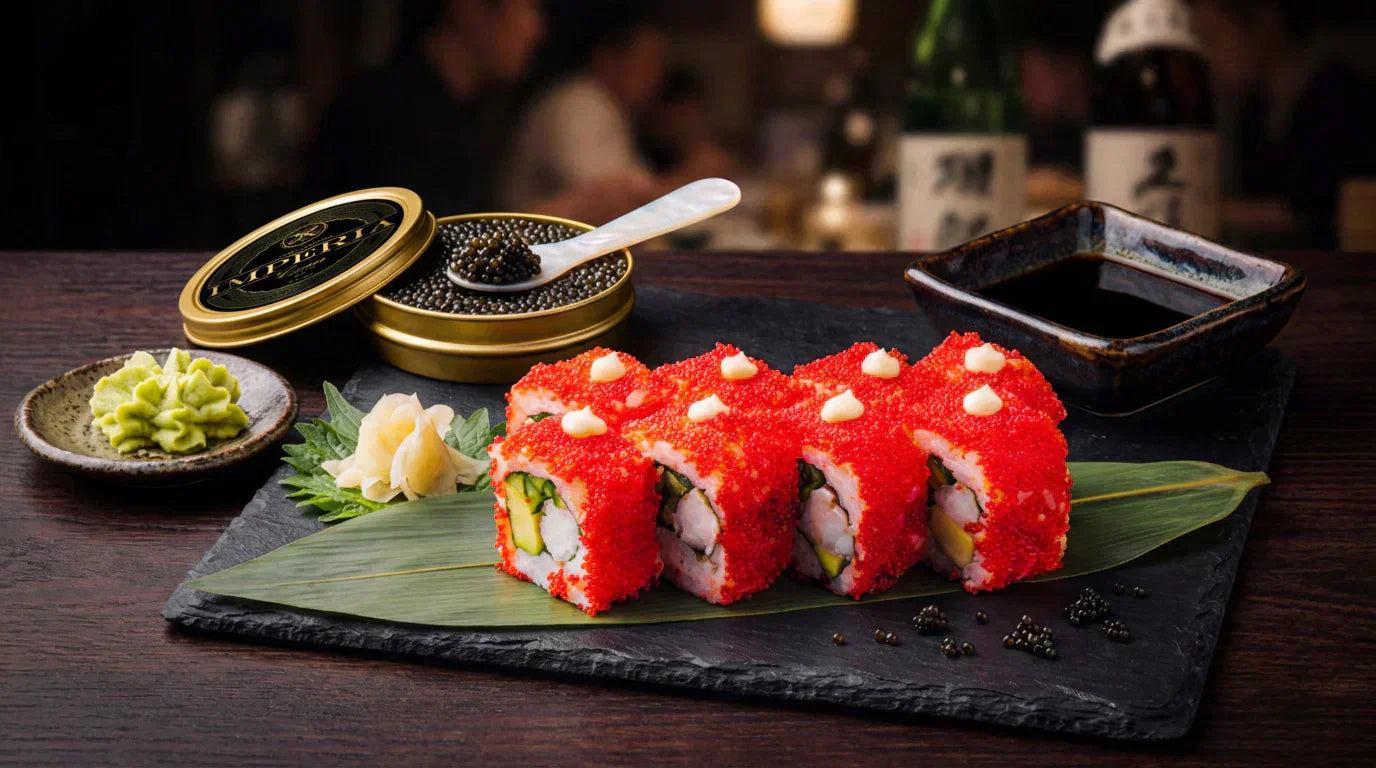
Tobiko is treated as a garnish and texture accent. It’s sprinkled over California rolls, scattered across gunkan maki, folded into poke bowls, or used to coat the exterior of inside-out sushi. Tobiko adds color and crunch to composed dishes. It’s rarely the star.
You savor caviar. You sprinkle tobiko.
Price: What You’ll Actually Pay
Caviar prices range widely by species and grade. Entry-level options like Siberian sturgeon or Hackleback start around €45 per ounce. Mid-range Osetra runs €70–€135 per ounce. Beluga and rare golden Osetra can exceed €280 per ounce.
Tobiko occupies a different pricing tier. A full ounce typically costs €4–8. Eight ounces of tobiko costs roughly what a single ounce of mid-grade caviar does.
The price gap traces back to biology. Sturgeon supply is inherently limited because females need years to produce harvest-quality roe. Flying fish are abundant, reproduce quickly, and require simpler processing.
Imperia offers caviar at every price point, from accessible Siberian sturgeon to rare Beluga. See current prices!
Nutrition: How Caviar and Tobiko Compare
Both caviar and tobiko pack substantial nutrition into small servings. Here’s how they compare per 1-ounce (28 g) serving:
|
Nutrient (per 1 oz) |
Sturgeon Caviar |
Tobiko |
|
Calories |
70–75 kcal |
35–40 kcal |
|
Protein |
7 g |
4 g |
|
Omega-3 Fatty Acids |
1,000–1,100 mg |
800–900 mg |
|
Cholesterol |
165 mg |
100–120 mg |
|
Sodium |
420–500 mg |
200–280 mg |
Both are strong sources of vitamin B12, vitamin D, and selenium. Caviar delivers more protein and omega-3s per serving but also more sodium and cholesterol.
A one-ounce serving of caviar contains roughly 20% of the daily recommended sodium. Tobiko is lower in sodium but still best enjoyed in measured portions.
Sustainability: Sturgeon Farming vs Flying Fish Harvesting
Wild sturgeon populations face severe pressure. Most species carry CITES listings, meaning international trade in wild-caught sturgeon roe is either banned or tightly regulated. The vast majority of commercial caviar now comes from aquaculture. Farmed operations control breeding, water quality, and harvest timing to produce consistent roe without depleting wild stocks.
Some farms use no-kill harvesting methods that extract roe without sacrificing the fish, though this remains a small share of production. Imperia Caviar sources from eco-friendly aqua farms committed to responsible sturgeon husbandry.
Flying fish are not endangered or CITES-listed. Tobiko harvesting carries a lower environmental footprint overall. However, it operates with less regulatory scrutiny than sturgeon aquaculture. For EU consumers concerned about traceability, farmed caviar often provides a clearer chain of custody than wild-harvested tobiko.
Tobiko vs Masago vs Ikura: Other Roe Worth Knowing
Tobiko is often confused with two other types of roe in Japanese cuisine. Masago is capelin roe. The eggs are smaller than tobiko, with a grainier, sandier texture and a slightly bitter finish. It’s frequently used as a cheaper substitute.
Ikura is salmon roe. The eggs are much larger (5–8 mm), bright orange-red, and deliver a rich, sweet pop. Ikura is popular in both Japanese and Russian cuisine.
These four (caviar, tobiko, masago, and ikura) represent the main categories of culinary roe. Each serves a different role at the table.
Conclusion
Caviar and tobiko are both fish eggs, but that’s where the overlap ends. Caviar is a standalone luxury built on complex flavor and careful processing. Tobiko is a colorful, crunchy garnish that brightens composed dishes at a fraction of the cost.
Neither is better in absolute terms. Caviar belongs at occasions where depth of flavor is the point. Tobiko belongs on plates where texture and visual pop matter most. Knowing the difference between caviar and tobiko means choosing the right one for the right moment.
Explore Imperia’s full selection of caviar and premium roe, shipped fresh to your door!


