

Mother of Pearl Serving Spoon: Why It Matters and How to Choose One
Quick Answer: A mother of pearl serving spoon is carved from nacre, the iridescent inner layer of mollusk shells. Because nacre is inert, it will not react with caviar's salt, acid, or fat the way metal does, which prevents a tinny, bitter taste.
Key takeaways:
-
Mother of pearl (nacre) is the iridescent inner layer of mollusk shells. It is smooth, dense, and chemically inert.
-
Metal spoons oxidize on contact with caviar’s salt and fat, producing a metallic taste that masks the roe’s true flavor.
-
Nacre is the gold standard, but bone, horn, gold, glass, and food-grade plastic are acceptable non-reactive alternatives.
-
Choose spoons by size: 7–10 cm for individual tasting, 10–13 cm for serving. Verify authenticity by checking for natural iridescence and minor surface irregularities.
-
Hand-wash only, never dishwasher. Store separately from metal cutlery to prevent scratches.
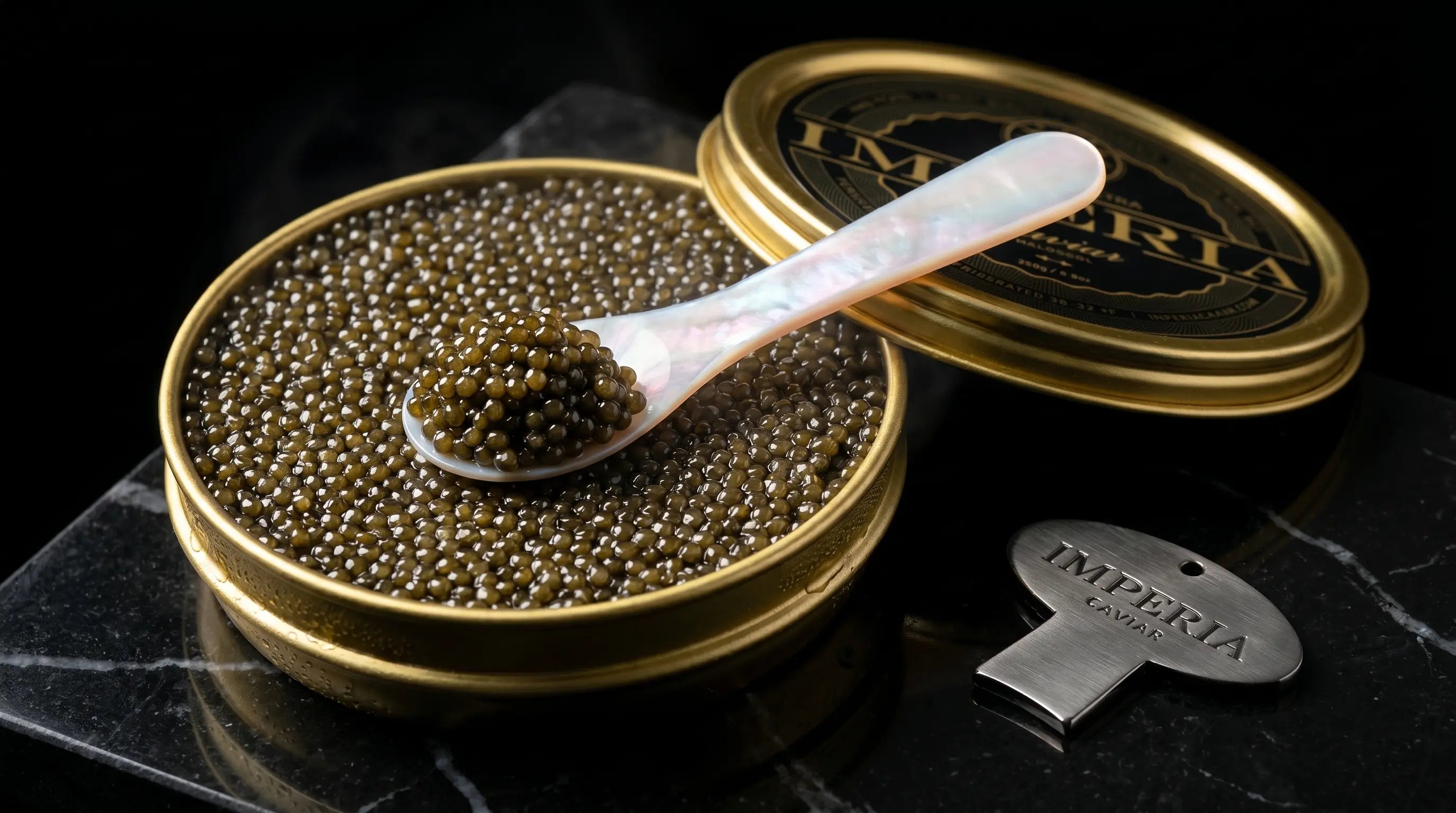
If you have browsed a caviar bar, opened a premium gift set, or scrolled through fine dining photos, you have seen them: small, iridescent spoons resting beside tins of roe. Those are mother of pearl serving spoons. They exist for a practical reason, not just an aesthetic one.
The wrong spoon can chemically alter the taste of caviar worth hundreds of euros per tin. The difference between nacre and stainless steel is not subtle once you know what to look for.
This guide covers what nacre is, why it protects caviar, how it compares to other spoon materials, and how to choose and care for one.
What Is Nacre (Mother of Pearl)?
Nacre is a composite material produced inside the shells of certain mollusks, including oysters, abalone, and mussels. It is the same substance that forms pearls.
Structurally, nacre consists of microscopic platelets of aragonite (a form of calcium carbonate) bonded by thin layers of organic proteins.
This layered architecture creates the distinctive iridescence of mother of pearl. Light refracts between the stacked platelets, producing a shifting rainbow effect that changes with viewing angle. The sheen is not a coating. It is the internal structure of the material itself.
The properties that matter for serving food are straightforward. Nacre does not corrode, oxidize, or react with salt, acid, or fat.
Its surface is naturally smooth at a microscopic level, so it will not scratch or tear delicate food membranes. It is dense enough for daily use, yet cool to the touch, which complements chilled service.
Why Metal Spoons Ruin Caviar
Caviar is a mixture of salt, water, and unsaturated fats held inside fragile egg membranes. Premium roe is preserved using the malossol method, which applies only 3–5% salt. That light brine keeps the caviar fresh, but it also makes the roe highly reactive on contact with certain surfaces.
When caviar sits on a silver, stainless steel, or nickel spoon, the saltwater brine triggers oxidation. This reaction transfers metallic ions into the thin film of liquid coating the roe. The result is a tinny or bitter taste that masks the roe’s natural buttery richness, clean brine, and nutty or mineral finish.
Texture suffers too. Metal edges and rough surfaces can crush or tear the delicate membranes of individual eggs. That intact pop when you press a bead against your palate depends on those membranes arriving undamaged.
Nacre sidesteps both problems. It is inert, so the brine has nothing to react with. Its polished surface lets the eggs glide without friction or damage. What reaches your palate is exactly what the producer intended: pure roe, unaltered. For a deeper look at how different spoon materials affect the tasting experience, see our guide to why caviar spoons matter.
Every Imperia Caviar gift set includes a genuine mother of pearl spoon, so the right utensil is always part of the package. Browse our caviar collections to find the right set!
Caviar Spoon Materials Compared
|
Material |
Reactivity |
Flavor Impact |
Durability |
Price Range |
Aesthetics |
Best For |
|
Mother of Pearl |
None |
Zero |
High |
€12–€45 |
Iridescent, elegant |
Caviar, fine dining |
|
Bone / Horn |
None |
Zero |
High |
€10–€30 |
Rustic, warm |
Traditional service |
|
Gold (solid) |
Very low |
Negligible |
High |
€200+ |
Luxurious |
Statement pieces |
|
Wood / Bamboo |
None |
Minimal |
Medium |
€5–€15 |
Earthy, casual |
Informal serving |
|
Glass |
None |
Zero |
Low (fragile) |
€8–€25 |
Modern, sleek |
Visual presentation |
|
Plastic |
None |
Zero |
High |
Under €5 |
Basic |
Budget, events |
A few points the table cannot capture. Gold is technically non-reactive, but most affordable “gold” spoons are plated over a reactive base metal like brass or nickel. Once the plating wears through, the same oxidation problem returns. Only solid high-karat gold avoids this, which explains the price gap.
Wood and bamboo are inert and inexpensive, but they absorb moisture and odors over time. They work for casual service but are not ideal for repeated caviar use. Glass is perfectly neutral but fragile; one drop on a stone countertop and it shatters.
Mother of pearl occupies the practical middle ground: non-reactive, durable, visually striking, and affordable enough to include with every caviar purchase.
Its only real weakness is that it requires gentle handling (no dishwasher, no hard impacts). For most buyers, that tradeoff is trivial.
How to Pick the Right Mother of Pearl Spoon
Size and Shape
Caviar tasting spoons are typically 7–10 cm (3–4 inches) long. This size fits comfortably between the fingers and carries a thin, single layer of roe, which is the proper way to taste.
Serving spoons run 10–13 cm (4–5 inches). These are for scooping caviar from the tin onto guests’ plates, blini, or the back of the hand. The slightly larger bowl handles repeated service without constant reloading.
Anything above 13 cm is better suited to jams, condiments, or dips. Regardless of size, the bowl should be shallow and oval, not deep and round. A shallow bowl lets roe spread in a single layer, making it easier to see bead quality and avoid crushing eggs at the bottom.
How to Spot a Fake
Authentic nacre has a natural iridescence: soft, shifting rainbow reflections that change as you tilt the spoon. Fakes look uniformly white or carry a painted shimmer that stays static.
Genuine spoons show minor surface irregularities. No two are identical, because each is carved from a natural shell. Mass-produced plastic imitations are perfectly uniform.
The temperature test is simple. Real nacre feels cool to the touch and warms slowly in your hand. Plastic warms almost instantly. Price is another signal: authentic mother of pearl spoons typically cost €12–€45 each. Anything significantly cheaper is almost certainly synthetic.
All Imperia Caviar mother of pearl spoons are hand-finished from genuine nacre. Browse our spoon collection to find the right size for your service!
How to Care for a Mother of Pearl Spoon
Do:
-
Rinse under lukewarm water immediately after each use.
-
Clean with a drop of mild, fragrance-free dish soap and a soft cloth.
-
Dry immediately with a soft towel. Do not air-dry.
-
Store in a lined drawer, soft pouch, or presentation box, away from metal cutlery.
-
Buff with a dry microfiber cloth if the surface dulls over time.
Do not:
-
Put it in the dishwasher. High heat and harsh detergent cloud the surface and cause hairline cracks.
-
Use hot water, abrasive pads, scouring powders, bleach, or ammonia-based cleaners.
-
Store loose in a cutlery drawer where metal knives and forks can scratch the nacre.
That is the full care routine. Nacre survived saltwater inside a mollusk shell for years before becoming your spoon. Treat it gently, and it will last for decades.
Beyond Caviar: Other Uses for Mother of Pearl Spoons
The same properties that protect caviar make nacre spoons useful for other delicate foods. Any ingredient where purity of flavor and gentle handling matter is a good candidate.
Common uses beyond caviar include:
-
Salmon roe and trout roe (same reactivity concerns as sturgeon caviar).
-
Uni (sea urchin), where the creamy texture tears easily on rough surfaces.
-
Fine sea salts and finishing salts for tableside service.
-
Soft cheeses, jams, and preserves where metal can discolor or taint delicate spreads.
-
Spice blends and saffron, where precise, small portions matter.
Conclusion
A mother of pearl serving spoon is the simplest way to ensure premium caviar tastes exactly as the producer intended. Nacre is inert, smooth, and beautiful. Metal is reactive, abrasive, and unnecessary.
The choice is not about luxury for its own sake. It is about preserving the flavor of roe you paid good money for. Once you taste the difference, the mother of pearl spoon stops being an accessory and becomes a requirement.
Explore Imperia Caviar gift sets, each paired with a genuine mother of pearl spoon!


