

Best Cheese for Caviar: A Complete Buying Guide
Quick Answer: The best cheese for caviar is a soft, mild, creamy one that supports the briny pearls without overpowering them, with crème fraîche, mascarpone, and fresh chèvre being the safest choices across all varieties.
Key takeaways
-
Crème fraîche, mascarpone, and fresh chèvre are the three safest pairings across all sturgeon varieties.
-
Match cheese intensity to caviar intensity: mild with mild, robust with robust.
-
Look for AOP, PDO, or DOP labels when buying in Europe to guarantee quality and provenance.
-
Avoid blue cheeses, strong washed-rind cheeses, heavily aged hard cheeses, smoked cheeses, and herbed varieties.
-
Serve cheese at 15 to 18 degrees Celsius, caviar on crushed ice, and use a non-metal spoon.
The tin is in the fridge and guests are coming. Now the only thing between you and a memorable tasting is the cheese you put underneath.
Pick the wrong one and €100 of Ossetra vanishes under mould or smoke or a rind that was never meant to meet roe.
In this guide to the best cheese for caviar. Every variety, every AOP label, every price band, and every cheese that never makes the cut.
The Caviar and Cheese Pairing Matrix
Find the caviar you already have, or are about to buy, on the left. The rest of the row tells you exactly what to serve with it.
|
Caviar |
Flavour profile |
Best cheese match |
Bold alternative |
Cheese to avoid |
Suggested drink |
|
Ossetra |
Nutty, buttery |
Fontina Val d'Aosta DOP |
Comté AOP (12 to 18 months) |
Mimolette |
Blanc de Blancs Champagne |
|
Kaluga Hybrid |
Bold, large pearls |
Comté AOP (12 months) |
Young Gouda |
Roquefort |
Brut Champagne |
|
Sevruga |
Briny, mineral |
Young Gruyère AOP |
Mascarpone |
Époisses |
Premium chilled vodka |
|
Beluga |
Delicate, creamy |
Crème fraîche |
Camembert de Normandie AOP |
Blue cheeses |
Blanc de Blancs Champagne |
|
Siberian (Baerii) |
Mild, approachable |
Crème fraîche |
Fresh chèvre |
Smoked cheeses |
Sancerre or Chablis |
If you are already browsing Ossetra or Kaluga, the matrix above tells you which cheese to buy on the way home.
Browse the Imperia Caviar collection and match your choice to a cheese below.
How to Choose Cheese for Caviar: The Three Rules
Three rules govern every good caviar and cheese pairing. They have held up across decades of chef-led tastings.
They are the fastest way to narrow your options when you are standing in front of a crowded fromagerie.
Rule 1: The Cheese Is the Supporting Act, Not the Star
The cheese's job is to carry the caviar, not compete with it. The pop and brine of the pearls is what you paid for, and a loud cheese buries both sensations in a single bite.
A wedge of mature Roquefort will overwhelm a 30-gram tin of Ossetra completely. That is 90 euros lost to a cheese that belonged on a different plate.
Rule 2: Match Intensity to Intensity
A gentle caviar needs a gentle cheese. A bolder caviar can take, and benefits from, a more assertive one.
Beluga with crème fraîche is the classic delicate-with-delicate pairing. Sevruga with young Gruyère AOP is the briny-mineral with saline-nutty pairing that brings both ingredients up to full voice.
Crème fraîche is the universal exception because it is a neutral canvas. If caviar is new territory, start there, and use our guide to caviar varieties to match each tin to the right cheese.
Rule 3: Soft Texture Beats Hard Texture
Hard cheeses require too much chewing. Chewing hides the caviar's pop, which is half the experience. Soft, spreadable, or melting cheeses preserve the textural contrast between the pearls and the base.
The exception is paper-thin shavings of aged Comté or young Gruyère, used sparingly. A useful rule of thumb: if the cheese takes more than two seconds to chew, use it thinly or pick something else.
The 9 Best Cheeses for Caviar: Profiles and Buying Notes
The nine cheeses below are ordered from safest for beginners to most ambitious. Each profile follows the same six-part template so you can scan, compare, or skip the ones you already know.
A brief word on labels. AOP (Appellation d'Origine Protégée), PDO (Protected Designation of Origin), and DOP (Denominazione di Origine Protetta) are the same idea in three languages.
The label guarantees origin, production method, and minimum aging. A supermarket Brie and a Brie de Meaux AOP look similar on the shelf. They do not taste the same, and they do not carry a spoonful of Ossetra the same way.
1. Crème Fraîche: The Default
Crème fraîche is technically cultured cream rather than cheese, but every caviar guide treats it as one. Its subtle tang brightens the caviar's richness without competing, and its smooth fat carries the pearls.
Best with. All varieties. It is especially strong with Imperia Beluga and Imperia Siberian, where the caviar's delicacy needs the lightest hand.
What to look for on the label. French crème fraîche, ideally from a producer using the Crème d'Isigny AOP designation. Minimum 30 percent fat. No stabilisers such as gellan or xanthan gum.
EU price band. Around 4 to 8 euros per 200-gram pot at a well-stocked supermarket. Around 10 to 14 euros for a genuine Isigny AOP jar at a fromagerie.
Substitutes. Fromage blanc if you want a lighter texture. Full-fat sour cream if you only have what is in the fridge.
How to serve it. Straight from the fridge. A generous teaspoon on the blini, caviar on top. Never heated.
2. Mascarpone: The Creamy Canvas
Mascarpone is an Italian triple-cream fresh cheese that reads as a richer, rounder alternative to crème fraîche. The luxurious mouthfeel and mild dairy sweetness balance caviar salinity, and the texture spreads cleanly onto canapés.
Best with. Imperia Sevruga. The bolder brine survives mascarpone's weight. It also pairs well with Ossetra.
What to look for on the label. Italian origin. "Mascarpone di Lodi PAT" is the regional benchmark if you can find it. Minimum 40 percent fat, single-origin Italian milk. Avoid "mascarpone-style" or heavily stabilised supermarket brands.
EU price band. Around 3 to 6 euros per 250-gram tub at supermarkets. Around 7 to 11 euros at an Italian deli.
Substitutes. Brillat-Savarin, a French triple-crème with a bloomy rind. Fresh ricotta whipped smooth with a pinch of salt.
How to serve it. Let it sit at room temperature for 15 minutes before serving so the texture is spreadable. Use on toasted brioche rather than a thin blini. Mascarpone needs a sturdier base.
3. Fresh Chèvre (Chèvre Frais): The Bright Counterpoint
Young fresh goat cheese brings a clean, grassy tang that works as a bright counterpoint to caviar's oceanic brine. The texture is creamy but not heavy, and the bright white colour is striking against dark pearls.
Best with. Imperia Royal Ossetra. The nutty-sweet notes find a partner in chèvre's grassy tang. It also pairs well with Siberian Baerii as a beginner option.
What to look for on the label. French or Spanish origin. "Lait cru" (raw milk) if you want a stronger flavour. Under two weeks old for the freshest profile. Avoid aged or ash-coated varieties. Too assertive here.
EU price band. Around 3 to 5 euros per 100-gram log at supermarket level. Around 6 to 9 euros for an AOP chèvre like Sainte-Maure de Touraine AOP from a fromagerie.
Substitutes. Fresh ricotta, or fromage blanc.
How to serve it. Spread thinly on cucumber rounds if you want to keep the bite light. Spread on a toasted baguette slice if you want more substance. Finish with snipped chives.
4. Brie de Meaux AOP: The Safest Classic
Supermarket "brie" is not the same product as Brie de Meaux AOP. The AOP mark means raw milk from the Meaux region, a minimum of four weeks aging, and a specific pâté texture.
Why it works. The creamy, bloomy rind and soft interior literally melt onto the palate. It is the most well-known soft-ripened cheese in the world. When it is the real thing, it is a foolproof pairing for almost any caviar.
Best with. Ossetra and Beluga.
What to look for on the label. "Brie de Meaux AOP" (or "AOC" on older stock). "Lait cru de vache" (raw cow's milk). Aged a minimum of four weeks. Avoid pasteurised "brie" with no AOP mark.
EU price band. Around 20 to 32 euros per kilogram at a fromagerie, so roughly 4 to 7 euros for a 200-gram wedge. Supermarket non-AOP brie is half that. It is not the same experience.
Substitutes. Brie de Melun AOP, Coulommiers, or Brillat-Savarin for a richer alternative.
How to serve it. At 15 to 18 degrees Celsius (room temperature, not fridge-cold). Thin triangles on unsalted crackers, caviar on top, eaten immediately.
5. Camembert de Normandie AOP: The Complex Classic
Camembert is Brie's earthier, more complex cousin. The rind is slightly funkier, the interior richer, and the flavour leans more toward mushroom and cream. When ripe, it matches caviars that have more complexity of their own.
Best with. Imperia Beluga when you want a classical pairing with more character. It also pairs well with Ossetra.
What to look for on the label. "Camembert de Normandie AOP", "lait cru" (raw milk), traditional wooden box packaging. Ripe but not over-ripe: a gentle give when pressed, no ammonia smell.
EU price band. Around 5 to 9 euros per 250-gram wheel at fromageries. Around 3 to 5 euros at supermarkets for non-AOP "Camembert", which is a different product.
Substitutes. Brie de Meaux AOP (milder) or Coulommiers (close cousin).
How to serve it. Room temperature for 30 to 45 minutes before serving. Thin wedges on rye crackers. The earthiness benefits from rye's depth.
6. Burrata: The Luxurious Contrast
Burrata is an Italian cream-filled fresh cheese with a firm mozzarella exterior and a runny cream interior. The stracciatella inside makes a silky canvas for the pearls, and the outer shell gives structural contrast. The visual drama is part of the appeal.
Best with. Ossetra and Sevruga. It is not ideal for Beluga, where the burrata's creaminess can overshadow the caviar's delicacy.
What to look for on the label. Italian origin. Production date within 48 hours of purchase. Burrata is genuinely fresh, and stale burrata turns rubbery. "Burrata di Andria IGP" is the benchmark.
EU price band. Around 5 to 10 euros per 125-gram ball from a good deli. Around 3 to 4 euros at supermarkets for non-IGP.
Substitutes. Fresh mozzarella di bufala DOP, or stracciatella on its own.
How to serve it. At room temperature, torn open rather than cut, so the cream spills onto the plate. A spoonful of caviar directly on the cream. No blini. The burrata itself is the base.
7. Young Gruyère AOP: The Saline Companion to Sevruga
Young Gruyère AOP (aged 5 to 8 months) carries a saltiness and minerality that echoes Sevruga's brine, plus enough sweetness to balance it. Older Gruyère becomes too assertive for caviar.
Best with. Imperia Sevruga as the primary match. It is not suitable for Beluga or Baerii. Too much cheese flavour.
What to look for on the label. "Le Gruyère AOP", aged 5 to 9 months (labels often say "doux" or "mild"). Avoid "réserve" (12 months and up), "vieux" (15 months and up), and any hard-aged alpage version.
EU price band. Around 25 to 40 euros per kilogram at fromageries, or roughly 3 to 5 euros for a 100-gram wedge.
Substitutes. Young Emmentaler AOP, or young Abondance AOP (harder to find but more refined).
How to serve it. Shave it into thin slivers, not cubes. Place on a neutral cracker with caviar on top. Use small amounts: a teaspoon of shaved cheese per bite.
8. Comté AOP: The Nutty Companion to Kaluga
Comté AOP aged 12 to 18 months offers hazelnut, brown butter, and a hint of tropical fruit. It scales perfectly against Kaluga's large pearls and bold pop, which is why it is the classic pairing for the variety.
Best with. Imperia Kaluga Hybrid as the primary match. Ossetra is a close second.
What to look for on the label. "Comté AOP", affinage 12 to 18 months (bronze or silver bell insignia on the rind). Avoid "Comté extra-vieux" (24 months and up). Too assertive for caviar.
EU price band. Around 22 to 35 euros per kilogram at fromageries for 12 to 18-month Comté, or roughly 3 to 5 euros for a 100-gram wedge.
Substitutes. Beaufort AOP, or young Abondance AOP.
How to serve it. Paper-thin shavings using a cheese plane, not a knife. Two or three shavings on a neutral cracker, caviar on top. The flavour intensity means a little goes a long way.
9. Fontina Val d'Aosta DOP: The Melt-in-Mouth Companion to Ossetra
Fontina Val d'Aosta DOP softens to a near-melting consistency at room temperature. The earthy mushroom notes dovetail with Ossetra's nuttiness. The name matters: "Italian Fontina" and "Fontal" are imitations of the real thing.
Best with. Ossetra as the primary match. It works with Kaluga Hybrid. It is not ideal for Beluga. Too much flavour.
What to look for on the label. "Fontina Val d'Aosta DOP" only. The wheel is stamped with the Matterhorn logo. Avoid anything labelled just "Fontina" or "Fontal".
EU price band. Around 18 to 28 euros per kilogram, or roughly 3 to 5 euros for 100 grams.
Substitutes. Taleggio (a washed-rind, so careful with quantity). Raclette de Savoie (stronger).
How to serve it. At 18 to 20 degrees Celsius so it is soft but not molten. Thin slices on crostini with Ossetra on top. It works especially well in a composed bite rather than on a buffet.
Nine profiles, five caviars, and a matrix that tells you which to put together. If one of the cheeses above is already in your fridge, pick the caviar variety that matches it.
Choose a caviar from the Imperia collection and the rest of the pairing writes itself.
Cheeses to Avoid With Caviar (And Why)
Knowing what not to buy saves money and reputation. Five categories of cheese reliably overwhelm caviar, and each one is easy to recognise on the shelf.
Blue Cheeses
Roquefort, Stilton, and Gorgonzola are too assertive. The mould notes and heavy salt mask caviar entirely. You will not taste the caviar. Save the blue cheese for port or a cheese course, and serve it on a different plate.
Strong Washed-Rind Cheeses
Époisses, Taleggio, and Maroilles are too fragrant. The ammonia and funk compounds in washed-rind cheeses outrun caviar's more subtle marine notes.
A very young Taleggio (under 30 days old) can work with salmon roe. That is roe, not caviar, and it is an intermediate-level pairing.
Heavily Aged Hard Cheeses
Parmigiano-Reggiano DOP aged 24 months and up, Pecorino Romano, and Mimolette are too salt-crystalline.
The concentrated salt and tyrosine crystals overshadow caviar's own salinity. The chewing-time issue from Rule 3 is at its worst here. A 12 to 18-month Comté is the safe middle ground.
Smoked Cheeses
Smoked Gouda, Oscypek, and smoked scamorza overlay a flavour that competes directly with caviar's marine character. Smoke is louder than brine.
Every bite will taste of bonfire, not ocean. The one exception is smoked trout roe, not sturgeon caviar. Smoked with smoked works.
Herbed or Flavoured Cheeses
Boursin, pepper Jack, and any cheese rolled in herbs, pepper, or ash introduces a third flavour that has no business at the caviar table.
Adding garlic, pepper, or cranberries to a caviar bite throws three flavours at the palate that do not belong together.
If the cheese has anything on, in, or around it other than rind, pass.
How to Build a Caviar and Cheese Tasting Board
Now that you know what to buy, here is how to serve it. A good tasting board balances variety against palate fatigue, and it treats the caviar with the care it deserves.
Choose Two Caviars and Three Cheeses (The Classic Triad)
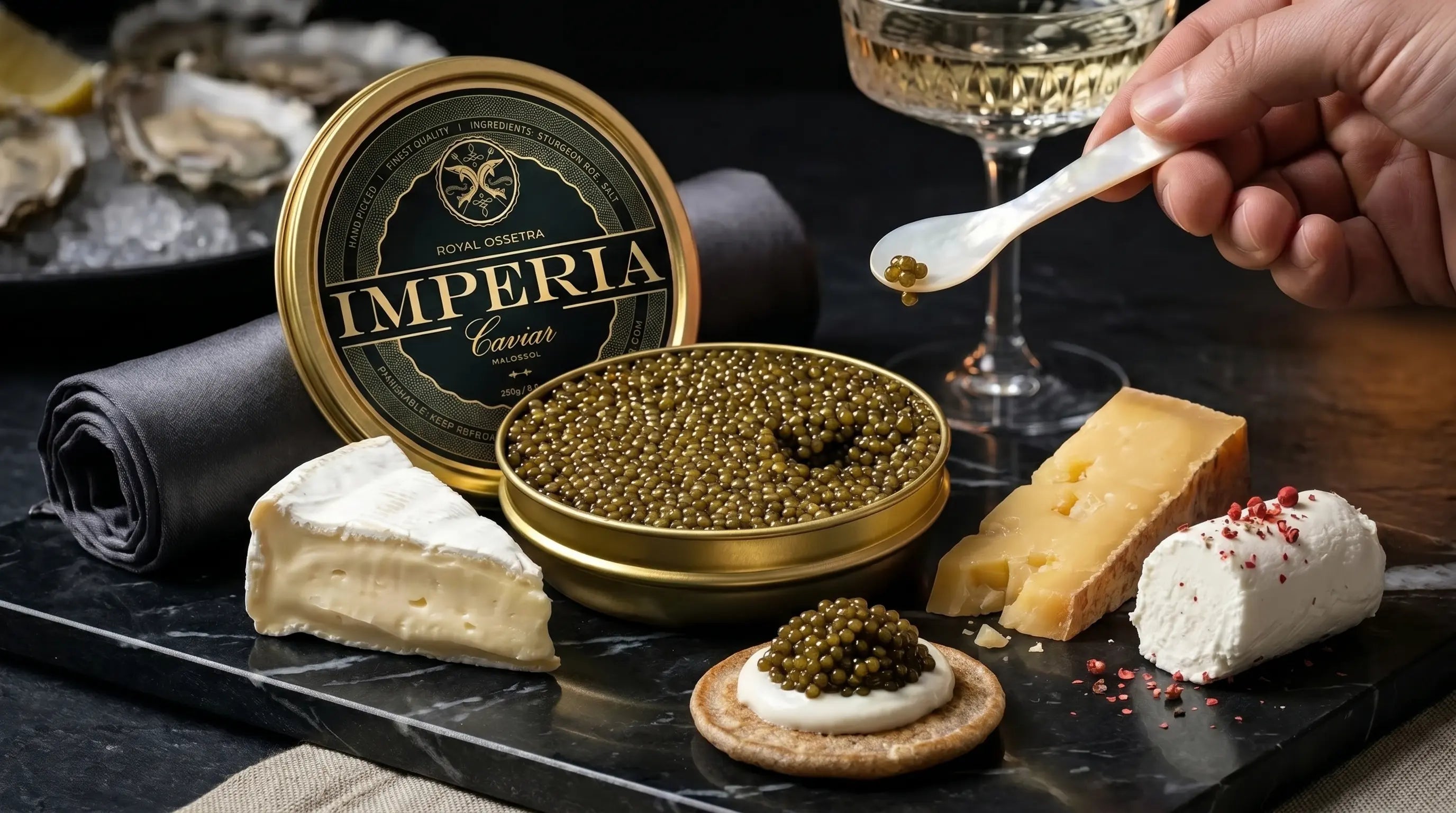
The ideal composition is two caviars and three cheeses. One approachable caviar, such as Imperia Siberian, and one premium, such as Ossetra or Kaluga. Three cheeses spanning fresh, semi-soft, and bolder styles: crème fraîche, Brie de Meaux AOP, and young Gruyère AOP is a proven lineup. This 2-by-3 gives six canapé combinations without overloading any taster.
Bases, Garnishes, and Utensils
Bases. Blinis for the soft cheeses. Thinly sliced toasted baguette for harder cheeses. Unsalted water biscuits for a neutral option. Cucumber rounds when you want to keep the bite light.
Garnishes. Finely chopped shallots, fresh chives, lemon wedges on the side (never directly on caviar). Skip capers (too assertive) and chopped hard-boiled egg (too dry).
Utensils. Non-metal only for caviar. Metal reacts with the roe and imparts a bitter, tinny flavour. Use a mother-of-pearl spoon, bone, or wood. Regular cheese knives are fine for the cheese.
Plating and Serving Temperature
Caviar stays in its original tin, nested in a bowl of crushed ice. Target caviar temperature is minus 2 to 0 degrees Celsius.
Cheese should be at 15 to 18 degrees Celsius, slightly cool room temperature, not fridge-cold. Pull it from the fridge 30 to 45 minutes before service.
Arrange caviar at the centre of the board, cheeses around the perimeter, and bases with garnishes at the outer edge.
Planning a tasting this weekend? Shop the Imperia Caviar collection!
How Much Caviar and Cheese to Buy Per Guest
For a tasting board, plan on 15 to 30 grams of caviar per guest. Use the lower end for canapés at a larger event, and the higher end when caviar is the tasting course. For cheese, allow 20 to 40 grams of each variety per guest on a three-cheese board.
A dinner for six guests works out to 90 to 180 grams of caviar in total. Add roughly 540 to 960 grams of cheese across the three varieties. Round up rather than down.
Caviar keeps for 48 hours refrigerated once opened, and most of these cheeses keep for a week. Running out mid-party is more expensive than leftovers.
Store unopened caviar in the coldest part of the fridge (0 to 4 degrees Celsius). Store unopened cheese in its paper wrapping in the cheese drawer, never sealed in plastic.
Wine and Champagne to Serve With Caviar and Cheese
Brut Champagne, ideally Blanc de Blancs, is the classical answer and the safest recommendation across every caviar variety. The acidity cuts through cheese's richness while the fine bubbles cleanse the palate between bites.
Three alternatives, from traditional to adventurous:
-
Chilled premium vodka, for the traditional Russian pairing. Clean, neutral, palate-resetting.
-
A dry unoaked white such as Chablis or Sancerre. Minerality and acidity that echo the caviar's oceanic character.
-
Dry sherry (fino or manzanilla) for the adventurous. Surprisingly strong with Sevruga and young Gruyère.
Avoid oaked Chardonnay, red wine, anything sweet, and anything floral. Each competes with caviar's marine character and confuses the cheese.
The Imperia Take
Finding the best cheese for caviar comes down to one rule: match the cheese's intensity to the caviar's intensity. Let the caviar stay the star of the plate.
The AOP, PDO, and DOP labels are the fastest way to guarantee that the cheese you buy will perform as expected.
That is what separates a European buying guide from the American versions, which ignore those labels entirely.
Pick a caviar, match it to one of the nine cheeses above, and you will not ruin a tin again.
Ready to put the matrix to work? Shop the full Imperia Caviar collection!


